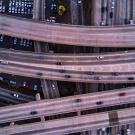
Concrete, the second-most-used material in the world, after water, requires significant resources for its production. A study in the journal Nature Sustainability from UC Davis researchers shows that global concrete production requires far more resources than previously estimated.
A carcinogen with potentially serious impacts on human health was found in neighborhoods in the months after the 2025 Los Angeles County wildfires and may have spread to communities as far as six to nine miles downwind from the fire zones, according to newly published work by University of California researchers.
Southern California is confronting another wildfire season while researchers from the University of California, Davis continue studying the lasting impacts of the devastating 2025 fires on air quality, human health and the environment. Their early findings are shaping future rebuilding strategies, public health precautions and fire resilience policies.
UC Davis scientists are in Antarctica to deploy Gull, an autonomous underwater vehicle known as a glider, that will help us understand how fast one of the world’s biggest and most important glaciers — Thwaites — is melting. Thwaites Glacier and neighboring Pine Island Glacier are potential glacial flow from the West Antarctic ice sheets. If this system collapses, it could raise sea levels across the world.
The U.S. government is in full retreat from its efforts to make vehicles more fuel-efficient, which it had been prioritizing, along with state governments, since the 1970s.
When a public building catches fire, its built-in systems automatically respond: Smoke alarms blare, sprinklers kick on, and occupants quickly evacuate.
But what if the life-threatening danger isn’t fire but invisible airborne contaminants that can make occupants sick? Could a similar smart-building system monitor and improve the quality of the air indoors, where Americans spend 90 percent of their time?
Air quality scientists have detected elevated levels of hexavalent chromium and silver in air samples collected from the debris cleanup zones for the Eaton and Palisades wildfires, which occurred January 2025 in Los Angeles County.
Lightweight, powerful lithium-ion batteries are crucial for the transition to electric vehicles, and global demand for lithium is set to grow rapidly over the next 25 years. A new analysis from the University of California, Davis, published May 29 in Nature Sustainability, looks at how new mining operations and battery recycling could meet that demand. Recycling could play a big role in easing supply constraints, the researchers found.
The University of California Pavement Research Center, or UCPRC, in collaboration with CalRecycle and Caltrans, repaved 1.1 miles of road on campus last week with innovative pavement materials made from end-of-life tires.
Now you have yet one more reason to clean your house. In recent work, former UC Davis postdoc Christoph Moschet and Prof. Tom Young showed that household dust contains hundreds of chemicals, including pesticides, pharmaceuticals, flame retardants, and organofluorine compounds. Around 90% of the chemicals they identified are human-made. Prof.
UC Davis researchers have developed low-cost, portable sensors to help California communities detect harmful air pollutants. Their goal is to provide real-time data on toxic metals, empowering residents and regulators to identify pollution sources and push for cleaner air.
Dean Corsi and his team have tested the durability and effectiveness of his codesigned Corsi-Rosenthal Box, a low-cost DIY filter that removes harmful air particles from wildfire smoke and indoor air pollutants. He’ll share his team’s new findings at the ACS Spring 2025 Spring Digital Meeting.
The water quality of Clear Lake — California’s largest natural freshwater lake — suffers from low-to-no-oxygen conditions that contribute to harmful algal blooms (HABs) and other issues, according to a report from the UC Davis Tahoe Environmental Research Center and the U.S. Geological Survey and that was led by Civil & Environmental faculty and researchers.
Construction materials such as concrete and plastic have the potential to lock away billions of tons of carbon dioxide, according to a new study by civil engineers and earth systems scientists at the University of California, Davis and Stanford University. The study, published Jan. 9 in Science, shows that combined with steps to decarbonize the economy, storing CO2 in buildings could help the world achieve goals for reducing greenhouse gas emissions.
Producing materials such as steel, plastics and cement in the United States alone inflicts $79 billion a year in climate-related damage around the world, according to a new study by engineers and economists at the University of California, Davis. Accounting for these costs in market prices could encourage progress toward climate-friendly alternatives.
Massive rainstorms. Earthquakes. Natural phenomena are constantly reshaping the world around us, sometimes with disastrous consequences. In the Rock Hardepisode of the hit public TV show Home Diagnosis Prof.'s Jason DeJong and Ross Bolanger and Dr.
The American Society of Civil Engineers has awarded the 2024 Raymond C. Reese Research Prize to Amit Kanvinde, Professor at UC Davis’s Dept. of Civil and Environmental Engineering (CEE) and Aditya Jhunjhunwala, his PhD student. The Raymond C. Reese Research Prize, created in 1970, is given to authors of an article that “describes a notable achievement in research related to structural engineering and which indicates how the research can be used,” according to the ASCE website.
Naturally occurring microbes could help stabilize the ground under buildings during earthquakes due to the way they reduce the water content in soils, according to new research.
One existing approach to stabilizing liquefaction-prone soils known as grouting is to inject concrete into the soil under vulnerable structures to cement the ground together.
Scientists at the UC Davis Center for Geotechnical Modeling have compiled the most detailed experimental data yet seen on how liquefaction-induced downdrag can add to the structural load applied to a pile foundation during earthquake shaking.
Prof. Mike Kleeman is one of the authors of recent research, published in the journal Science of the Total Environment, that demonstrates how switching to renewable energy like solar, wind, and water power will also reduce racial and ethnic disparities in exposure to air pollution.
Every year, we see more electric vehicles (EVs) on the road. By 2035, all new passenger vehicles sold in California will be EVs to help reduce greenhouse gas emissions and other harmful pollutants. As EVs take over, we need new approaches to deal with manufacturing EV batteries and the end-of-life challenges EV batteries face.
Civil and environmental engineering professor Sabbie Miller has received $1.5M in federal funding from the Department of Energy’s ARPA-E agency to advance the methods and metrics necessary to quantify greenhouse gas (GHG) sequestration in building materials.
The department is honored to be hosting Dr. Amit Varma as he delivers his 2021 T. R. Higgins Lecture "SpeedCore and Steel-Concrete Composite Construction: The Best of Both Worlds." This lecture will be held from 4-5 pm on March 11, 2022, in 1003 GiedtHall. There will be a reception after the event.
In a continuation of the Bischel team's work on wastewater analysis with Healthy Davis Together, Hannah Safford, Karen Shapiro, and Professor Bischel published an op-ed in the Proceedings of the National Academy of Sciences of the United States of America. The article, titled Opinion: Wastewater analysis can be a powerful public health tool—if it’s done sensibly, can be found here. Congratulations, Hannah and Professor Bischel!
CA Governor Gavin Newsom recently signed landmark legislation by State Senator Josh Becker that will make California the first state to directly target greenhouse gas emissions from cement. Senate Bill 596 also is the first bill in any California sector to focus on achieving net-zero emissions.
Decarbonizing California Transportation by 2045
Report to State Outlines Policy Pathways to Meet the Zero-Carbon Time Crunch
UC Davis News and Media Relations recently highlighted the research contributions of department faculty members Austin Brown, Dan Sperling, and grad group member Susan Handy for their work on the "Driving California’s Transportation Emissions to Zero" report.
Professor Brian Maroney speaker on panel at ASCE/SEI Symposium
Many UCD students and alumni attended the ASCE/SEI San Francisco Chapter hosted a symposium on resilience to mark the 30th anniversary of the Loma Prieta earthquake. The speaker panel consisted of representatives from BART, Caltrans, EBMUD, City of Oakland, and the San Francisco Office of Resilience and Capital Planning. This event presented a unique opportunity to learn about the resiliency efforts of major building and infrastructure agencies in the Bay Area.
Everyone knows cigarettes are bad for you. Much research has been done and because of that, legislators have put a lot of sales restrictions and taxes on them. This is why companies are developing new products that deliver nicotine such as vapes, small cigars and cigarillos that have sugary flavors to addict a new generation of users.
These newer products have really caught on, especially with young people, who are adopting them faster than they can be researched or regulated.
Lake Tahoe, with its iconic blue waters straddling the borders of Nevada and California, continues to face a litany of threats related to climate change. But a promising new project to remove tiny invasive shrimp could be a big step toward climate-proofing its famed lake clarity.
UC Davis’ Women in Water Research team announced it will take the plunge for the third consecutive year in the Trans Tahoe Relay, a 10-mile swim across the alpine lake — no wetsuits permitted.
The NSF-funded workshop, the product of a year and a half of planning by UC Davis civil and environmental engineering professors Alejandro Martinez and Jason DeJong, brought together 60 experts from engineering and science research, as well as industry, to foster dialogue and collaborations to better establish the field of bio-inspired geotechnics.
A return to more normal weather and streamflow conditions in 2018 saw Lake Tahoe’s annual clarity value improve dramatically to 70.9 feet. This represents a 10.5-foot increase over the 2017 value. That is according to a report of Lake Tahoe clarity released by the UC Davis Tahoe Environmental Research Center.
CEE Professor Heather Bischel and graduate student Hannah Safford were chosen to receive the top $40,000 prize from the U.S. Bureau of Reclamation's Pathogen Monitoring Prize Competition.
A small group of scientists and doctoral students from the University of California, Davis, recently returned from Antarctica, where they became the first group to collect turbulence measurements from an underwater glider beneath an ice shelf.
Professor Ross Boulanger and the rest of the team at the CGM were thrilled to have UC Davis Chancellor Gary May tour the Center for Geotechnical Modeling.
Mohamed Elkashef, a postdoc working with Civil and Environmental Engineering Professor John Harvey and University of California Pavement Research Center Associate Director David Jones, recently received a 2018-2019 Mistletoe Research Fellowship.
On June 12, the UC Davis Solar Decathlon team, led by Professor Frank Loge in the Department of Civil and Environmental Engineering, received the Excellence in Structural Engineering Award from the Structural Engineers Association of Central California for their work designing and building OurH2Ouse for the 2017 U.S. Department of Energy’s Solar Decathlon competition.
A University of California, Davis research team led by civil and environmental engineering professors Geoff Schladow and Alex Forrest, along with environmental science and policy professor Steve Sadro, is launching a new project this month to test and optimize a strategy to improve water clarity in Emerald Bay and Lake Tahoe.
UC Davis research by a team including CEE’s Dr. Frank Loge connecting electricity savings and urban water conservation was spotlighted in The Los Angeles Times.
The California Energy Commission awarded the Center for Water and Energy Efficiency at UC Davis $3.1 million to pilot-test a system to help water utilities optimize their energy use and reduce operational costs while continuing to meet customers’ water needs.